
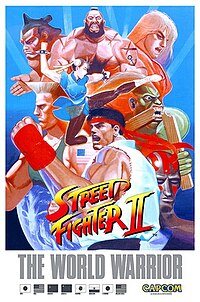
The Success Story
Known as the game that opened the flood gates to allow a plethora of fighting games to follow it in the 1990s, it was the game that everyone wanted to use their money on in the arcades. "The birth of the modern beat-em-up only really arrived with "Street Fighter 2", from Capcom in 1991." [3]. It would be re-released multiple times, each time with extra characters, more balanced gameplay and other slight changes due to the success of the first game. It would not be until 1992 that people could play the original game in their own home when it was ported to the SNES. This proved to be a very successful decision for Capcom. According to a 1992 issue of Gamest magazine in Japan, Street Fighter 2 was selling for 7 times the cost because of lack of stock, a sign of the lengths people would go to to own the game [4]. This led to "...pirates created an unsanctioned, copyright-infringing Famicom/NES version, which saw a very limited release in Asian markets." [7] due to the massive demand. Both the arcade and second iteration of the home version of the game (called Street Fighter 2: Champion Edition or Street Fighter 2: Dash in Japan) would go on to win the magazine's Best Game Award in 1991 and 1992 respectively, while the former would also win Best Action Game [4]. The award for best fighting game, like in the whole of the games industry, was yet to be established until later after the effect of what Street Fighter 2 had accomplished was noticed by other companies, spawning many clones and starting the boom of the beat-em-up. The game would go on to be ported to a number of different consoles, would be followed by 5 updated versions, strike a blow for female protagonists in an action game and spawn films and other such media. Since Street Fighter 2 many sequels in the franchise have been released and a worldwide fan culture has been built around the characters and moves-lists, attaining worldwide recognition.
Street Fighter 2 is undoubtedly the most successful game in the franchise and when it was released to arcades in 1991 noone could have expected the success that it would find. "Street Fighter II arrived and just exploded in popularity, as prolonged positive word of mouth from established arcade fanatics caused other game players to leave their homes and check out the revolutionary new thing in arcades." [5]. At the time, arcades had hit a low point as people were staying home to do their daily gaming. Street Fighter 2 helped change this as people queued up to challenge their friends and complete strangers for bragging rights and more time on the machine. "SF2 machines were hardly vacant for long, and most of the time had people lining up to insert quarters for 15-297 seconds worth of play. So arcade owners bought more machines and even clones when they emerged" [5]. However the success was nowhere near the universal appeal of games like Space Invaders and Pac-Man and even though many called it "The Greatest Game Ever", its primary gaming audience was made up of males from its appeal towards them [5].
The Winning Formula
As mentioned before, the original Street Fighter had found a niche and, with its follower, Capcom ran with it. But why was the game so successful?
1. Technology. With the release of the SNES and the Sega Genesis/Mega Drive, programmers had alot more space and technology to work with to create a much more fluid and visually stunning game that was like nothing else at the time. "Utilizing Capcom's proven CPS arcade chipset, which had powered the revolutionary large characters and colorful backgrounds of Final Fight, Yoshiki Okamoto's team developed a joystick and button scanning routine that would revolutionize the industry." [6]. Unlike in the first game, the animations were slick and the controls were too. Where you would try multiple times to perfect a move in the original game, Street Fighter 2 allowed players to enter controls quickly and efficiently, introducing new ways of inputting moves and play styles for each of the characters. Creating this mix of gameplay was something the first game in the franchise did not have and was a definite selling point for its sequel.
2. The Characters. Even though the characters were noted for being stereotypical, it did not stop them from being a strong reason for the games popularity. Coupled with the fact that there was no other one-on-one fighting game around at the time, Street Fighter 2 included 8 playable characters each with their own hidden move sets, "Street Fighter II was the first one-on-one fighting game to give players a choice from a variety of player characters, an option which created hitherto unknown levels of depth and replay value for an arcade game. Each player character had a fighting style with roughly 30 or more moves, including previously nonexistent grappling moves such as throws, as well as two or three special hidden attacks per character." [7].
The original 8 are now some of the most identifiable characters in gaming history.

Ryu and Ken are the only characters from the original Street Fighter that are playable in the first edition of Street Fighter 2 (Sagat, who is a sub-boss in arcade mode becomes playable in the Champion Edition of the game). They are joined by a host of new characters from around the world, including the sumo wrestler E. Honda, yoga master Dhalsim, pilot Guile, jungle monster Blanka, russian wrestler Zangief and the "first female of fighting games", police-woman Chun-Li. With such a vast array of characters for a game of its time (to be updated to 12 characters only a year later), everyone found their own favourite and made a bond with them, piling money into arcade machines to learn all their moves in hopes of defeating their friends next time they are challenged. In addition to this, "There were many advantages to this - for a start, you were much more likely to replay the game to find out what each of the characters looked like and what they did. Allowing people to evolve their own favourites and styles was a massive breakthrough." [3].
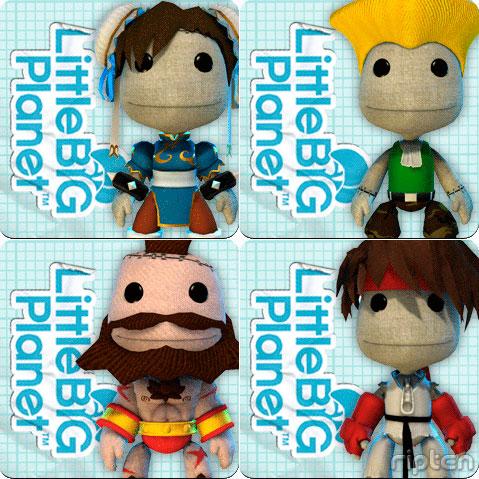
Even today the characters are still popular and recognizable in modern media. Above shows the customizable outfits of a "sackboy" from the downloadable content of the PlayStation 3 game "Little Big Planet" in the style of Chun-Li, Guile, Zangief and Ryu.
However it could be said that the character stereotypes negatively portray certain areas of the world that they originate from. When looking at the character and background level design of each of the characters, it could be said there is a bias against American and European culture in the game as the countries visited in the game in these regions include people drinking and acting rowdy in the background, whereas other areas depict feelings of serenity. "Overall, there seems to be clear bias against European and American culture in the game, or at least a bias that most people would find unfavorable. The three stages with no onlookers are all in Asia, and both Japanese stages have no onlookers. The only Asian stage with onlookers is China. In addition, the Russian and American stages depict people drinking. The fighters who are not Japanese are depicted as animalistic (Blanka), primitive (Dhalsim) or brutal (Zangief). Chun Li plays in a dirty area, but her fighting abilities are depicted as artistic. Guile and Ken are both depicted as good, clean fighters, but are marred by onlookers who are acting impolite. E. Honda is not depicted as an extremly beautiful fighter, but his stage is a symbol of cleanliness. Ryu combines a clean, beautiful fighting technique with a serene, beautiful location. So, to sum up, Street Fighter II seems to display Japanese culture in the best light, followed by America and China. The third world nations of India, Russia and Brazil come in extremly unfavorably." [9].
3. Character Specific Moves. With the large character roster came character specific "special" moves that only they could do. In addition to regular attacks, by adding special moves to the game the gameplay became far more tactical and stylish as certain attacks would hurl fireballs over the stage at your enemy or send you hurtling towards them feet first, while looking extremely cool. With this the game became far more re-playable. Special moves were not printed on the arcade machines so it was through word of mouth that moves like the elusive "HADOUKEN!" would be explained and shown to others. This adds the element of wanting to perfect that move that you just cannot seem to get right, so you put more money into the machine and you keep trying. When you finally succeed it's another weapon in your arsenal that you can add to your play style in the future. "What purpose does hiding the special moves have? Well, it adds to initial approachability at the cost of making it harder to master. And that's not necessarily a disadvantage to a fighting game, as mastery is supposed to be difficult. That helps to make matches more interesting since, early in a title's life at least, the players must work without full understanding of a game's options." [8].
4. The Controls. The inclusion of 6 usable buttons added much more strategy to the game. 3 punch and 3 kick buttons at varying strengths for each one enabled the player to balance their assault on their enemy. Strong attacks would take more damage off your opponent but would leave you more open to attack, while weak attacks would be quick and could break an opponents combo or defense if placed correctly.
[1] Street Fighter 2 still Capcom's best seller, retrieved 04/12/09
[2] Classic Game of the Week: Street Fighter 2, retrieved 04/12/09
[3] Simon Carless, Punch - Kick - Punch: A History of One-on-One Beat-Em-Ups, 24/04/98, retrieved 04/12/09
[4] "第5回ゲーメスト大賞" (in Japanese). GAMEST (68): 4, retrieved 04/12/09
[5] The History of Street Fighter, retrieved 04/12/09
[6] The History of Street Fighter, retrieved 04/12/09
[7] The History of Street Fighter, retrieved 04/12/09
[8] John Harris, Game Design Essentials: 20 Mysterious Games, 14/01/08, retrieved 04/12/09
[9] Ethnic Stereotypes in Street Fighter 2, retrieved 07/12/09

No comments:
Post a Comment