
What is it?
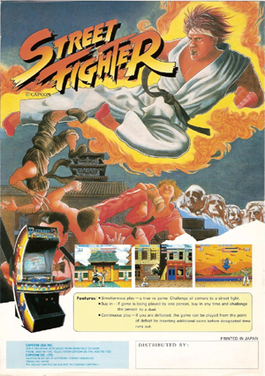
"Street Fighter" was first released to arcades in a specially designed cabinet, fitted with mechatronic, pressure sensitive pads that players would hit with different strengths to make their character release different kinds of punches and kicks on their enemy. This kind of hardware could have created quite a rudimentary type of immersion, however according to Jap-Sai.com, "Story has it that one player actually climbed up on top of the machine and drop kicked the bonus game (and control panel) into total and utter oblivion." [1]. To counteract this Capcom re-released it as a six button machine which proved to be a very successful idea.
The first game in the franchise introduced many of the ideas found in the later games. The side-scrolling, 2D, 1 versus 1 gameplay aspects of the game made their first appearance here, as well as much of the overall controls of the playable character. In addition to this it introduced simultaneous 2 player competitive gaming to the franchise. Street Fighter created a solid foundation for it's follower, the highly popular Street Fighter 2, to build upon.


Finding a Niche
Street Fighter was released at a time when there was nothing else much like it on the video games market. At the time there was much attention focuses on the games Hang On, Out Run and After Burner as they popularized the 3D simulation genre, which inadvertently allowed Street Fighter to find a niche . Street Fighter was something incredibly different to what was around at the time, drawing upon the games Yie Ar Kung Fu and Karate Champ that preceded it and creating a brand new gaming experience that gamers in arcades had never seen before. "Capcom, for its part, had studied both Data East's 1984 one-on-one fighting game Karate Champ and Konami's 1985 title Yie Ar Kung Fu before releasing its own game, Street Fighter, in 1987. Like Hang On, Out Run, After Burner and other 3-D simulation titles, Capcom's lonely Street Fighter had found a niche - it was different from everything else, and so people wanted to play it." [2].
Technological Limitations
Regardless of its popularity in its niche market, Street Fighter was nowhere near as well received as its predecessor. This could be due to the lack of technology advancements that allowed for a more streamlined gaming experience. "In the mid-1980's, however, one-on-one fighting games were in their infancy, and the limitations of technology prevented them from catching on. It was hard enough back then to program a game to recognize the fast motions of a joystick, let alone have eight or ten megabytes worth of game graphics or enough RAM to display one tenth of them at once." [3].
Gameplay with the joysticks was hit-and-miss as the game could not always keep up with what the player inputted. Even at the birth of the franchise players would still "button-bash", something prevalent in the fighting genre, where players would enter commands in incredibly quick succession in hopes of performing certain attacks. Of course this would occur unintentionally aswell, but as the game's controls were not incredibly responsive it would cause gameplay to become disjointed. 'Lacking animation to walk fluidly, characters staggered on the screen, and in the absence of a fluid control scheme, some moves took five or ten tries to execute while others shot out so quickly that opponents never had a chance to defend against them." [3].
[1] Street Fighter, retrieved 02/12/09
[2] The History of Street Fighter retrieved 02/12/09
[3] The History of Street Fighter retrieved 02/12/09

No comments:
Post a Comment